
Bridge Packages
A bridge package joins two packages that do not know about each other. Neither of them depends on the other. The bridge depends on both, and holds only what makes sense when both are installed.
The bundled scene package is built this way. It runs scenes, and needs no other package. Its
+help topics and its settings reach +help and +config through two bridges, scene-help and
scene-config:
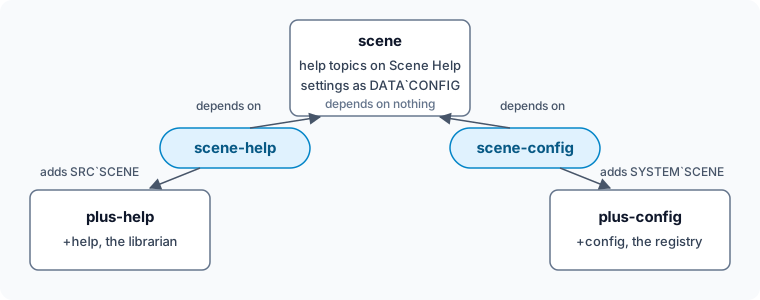
This page covers:
- why a package is split this way;
- the scene bridges, as a worked example;
- writing a bridge;
- when a dependency is the better choice.
For the places one package lets another change its behaviour, see Extension Points.
Why bridges
Section titled “Why bridges”A game installs the packages it wants. If scene depended on plus-help, a game could not run
scenes without also running +help, and removing +help would mean removing scenes first.
A bridge keeps each package whole on its own:
- Each package installs, upgrades and uninstalls without the other.
- No package checks at run time whether another is installed. The code that needs both is in the bridge, and the bridge is only there when both are.
- Uninstalling a bridge removes only the joining. The two packages are left as they were.
The scene bridges
Section titled “The scene bridges”scene keeps its own data in the shape the other packages read:
- Its help topics are a
HELPtree on its own Scene Help object, the way+helpreads topics. - Its settings are
DATA`CONFIG`<NAME>attributes on the Scene Logger, with the leaves+configreads: the type, the default, the limits and a description. The scene commands read each setting withget(), whether or not+configis installed.
On its own, nothing outside the package reads that data. Each bridge is the one registration that makes another package read it:
| Bridge | Depends on | What it adds |
|---|---|---|
scene-help | scene, plus-help | SRC`SCENE on the +help librarian, naming the Scene Help object, and a line at the end of +scene/help |
scene-config | scene, plus-config | SYSTEM`SCENE on the +config registry, naming the Scene Logger |
A new game installs plus-help, plus-config, scene and both bridges at its first start, so it
has +help scene and +config scene as before. A bundled bridge installs only where both of the
packages it joins are installed: a game that turned scene off does not get either bridge.
With and without the bridges
Section titled “With and without the bridges”Without scene-help and scene-config, scenes run as before, and +help and +config do not
know about them:
> +help scene[HELP] Warning: No local topic 'scene'. Try help scene or +help/search scene.> +config scene[CONFIG] Warning: No system is called scene. +config lists them.+scene/help still lists every +scene command, because the scene package has their usage lines
itself. With scene-help installed, the list ends with where to read more:
> +scene/help══════════════════════════════╡ Scene commands ╞══════════════════════════════+scene/activate <id>+scene/as <name>, or +scene/as on its own to pose under your own name again...+scene/upcoming [<days>|all]
+help scene explains them.══════════════════════════════════════════════════════════════════════════════
Settings changed while +config was not installed are kept. Here a game set two of them on the
Scene Logger directly, then installed plus-config and scene-config:
> &DATA`CONFIG`RECALL-ROUNDS <Scene Logger>=1Scene Logger/DATA`CONFIG`RECALL-ROUNDS - Set.> &DATA`CONFIG`DEFAULT-STATUS <Scene Logger>=newScene Logger/DATA`CONFIG`DEFAULT-STATUS - Set.> +config scene╔════════════════════════════╡ Settings: Scenes ╞════════════════════════════╗║ What a new scene starts as, which details players may set, and how much ║║ +scene/recall shows. ║║ ║║ Setting Value Allowed What it does ║║ -------------------------------------------------------------------------- ║║ default-status* new Active, new, or New scene status. What ║║ scheduled +scene/create makes: an ║║ active scene logs at ║║ once; new or scheduled ║║ waits for +scene/start. ║║ open-details yes Yes or no Open details. Whether an ║║ owner may set scene ║║ details the game does ║║ not list. ║║ recall-rounds* 1 A whole number from 1 to Recall rounds. How many ║║ 20 rounds of poses a bare ║║ +scene/recall shows. ║╠════════════════════════════════════════════════════════════════════════════╣║ * changed from its default. +config scene/<setting>=<value> changes one. ║╚════════════════════════════════════════════════════════════════════════════╝The whole of scene-help
Section titled “The whole of scene-help”format: "1.10"package: scene-helpversion: 1.0.0description: "Puts the scene topics into +help: registers the scene package's help with the +help librarian, and +scene/help points at +help scene."category: Scenes
depends: - package: scene version: ">=1.12" source: repo: https://github.com/SharpMUSH/SharpMUSH path: examples/packages/scene/ branch: main - package: plus-help version: ">=1.0" source: repo: https://github.com/SharpMUSH/SharpMUSH path: examples/packages/plus-help/ branch: main
objects: - ref: help_registration target: "{{plus-help/librarian}}" attributes: SRC`SCENE: |- {{scene/scene_help}}
- ref: help_pointer target: "{{scene/logger}}" attributes: FILTER`HELP`PLUSHELP: |- %0%r%r+help scene explains them.It creates no object. Both entries are attach entries: they add attributes to objects the other two
packages created, and uninstalling scene-help removes those attributes again. The second entry
uses the scene package’s HELP filter point.
Packages that add scene topics, such as scene-verse and radio-scene, attach them to the Scene
Help object. They reach +help through the same registration, and need no bridge of their own.
Writing a bridge
Section titled “Writing a bridge”- Keep your data where it belongs. The package keeps its own data on its own objects, in the
shape the other package reads: a
HELPtree for+help,DATA`CONFIGleaves for+config. Data nobody reads does no harm, and it is already there when the bridge arrives. - Put only the joining in the bridge. A registration leaf, a filter, an event attribute, a line on another package’s card. If the bridge grows commands of its own, it may be a package in its own right.
- Depend on both.
depends:on each package makes their objects legal attach targets, such as{{plus-help/librarian}}and{{scene/logger}}, and keeps either from being uninstalled while the bridge is attached to it. - Name it after both.
<package>-<other>, asscene-help,radio-sceneandroster-jobsare. Give it the category of the package it extends. - Read the other package’s data, not its code. When the bridge must call another object’s code,
use
@trigger/inline/nobreak/args, not@include: a{{ref}}in the included code is looked up on the object running it, which is the bridge’s caller, not the bridge. - Nothing assumes the bridge. The package’s own messages never send a player to a command from
the other package.
+scenesays+scene/help lists the commands, and the bridge adds the line about+help scene.
Changing a bridge bumps its version, as with any package. When the package it extends changes the
data a bridge reads, raise the bridge’s version: range on it.
Bridge or dependency
Section titled “Bridge or dependency”Depend on a package when yours cannot do its job without it: relationships-app draws the
relationships package’s data and has nothing to show without it.
Use a bridge when the other package adds an ability on top: a help topic, a setting screen, a line on a card, a scene log for the radio. Signs that a package wants a bridge:
- It depends on another package only to attach one registration leaf to it.
- It draws a section about another system, such as a room display that builds a scene block itself. The section belongs in a bridge that fills a point the display offers.
- Most of its commands are not about the other package. An availability calendar is mostly about when characters are free; showing who in a scene’s cast is free is the part that needs scenes.
- It reads another package’s fields for one line of output, such as a card line drawn from a profile’s fields.
The bundled bridges:
| Bridge | Joins | What it adds |
|---|---|---|
scene-help | scene, plus-help | The scene topics in +help |
scene-config | scene, plus-config | The scene settings in +config |
radio-scene | radio, scene | +radio/log: what a listener hears goes into their scene |
relationships-scene | relationships, scene | Last scene together on the +rel card and the name card |
roster-jobs | roster, jobs | Roster applications through the job queue |
health-jobs | health, jobs | Staff load in +health |
See also Softcode Packages and the package format.