
Chat Cards
A chat card is a short message drawn as a small panel, with one or more commands the reader can click. Dice results with a button to apply the damage, a scene invitation with Accept and Decline, a staff request with Approve: each is a chat card. SharpMUSH has no card feature of its own. A card is two things the game already has, put together:
- a layout such as
box()andfields(), which each client draws in its own way; - a command link, made with
cmdlink(), which the reader clicks to run a command.
This page builds an invitation card, from the panel to the commands behind its links. Most of the work is in those commands, because a link runs as whoever clicks it. The card is shown to one player, but the command it names can be typed by anyone, so each command checks who is running it.
The example on this page was run on a SharpMUSH server, and the output shown is what it printed.
What the reader sees
Section titled “What the reader sees”On a telnet client, the card Raya receives looks like this:
+=< Invitation 1 >===========================================================+| From: Wren || For: Tea at the Lantern, nine tonight |+============================================================================+| +invite/accept 1 +invite/decline 1 |+============================================================================+What each client makes of it:
| Client | The panel | The links |
|---|---|---|
| Telnet with UTF-8 | Box lines in the game’s border style | Clickable when the client supports MSLP, MXP or Pueblo |
| Telnet without UTF-8 | The ASCII box above | The same |
| The web portal | A card | Clickable |
| A screen reader | The text alone, in reading order | Read out as their text |
A client that cannot click a link shows its text. That is why the text of each link here is the
command itself: a player on a plain client can read +invite/accept 1 and type it.
How a click works
Section titled “How a click works”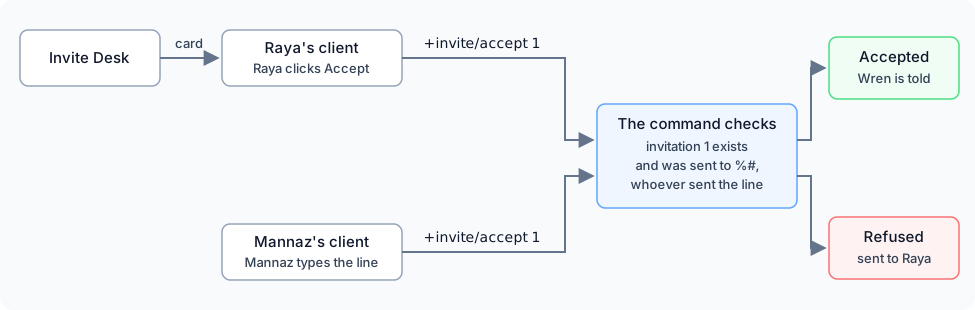
Clicking a link sends its command to the game exactly as if the reader had typed it. Nothing about the click tells the game which card it came from, or that it came from a card at all. So:
- The reader is the enactor. In the command,
%#is whoever clicked, not the player the card was sent to. - Anyone can type the command. Another player who guesses
+invite/accept 1sends the same line. Sending the card to one player does not limit who runs the command. - A card can be clicked late. The reader may click it an hour later, or twice. The command finds the invitation still waiting, or says it is gone.
- The link names an id, not a name or text. The command looks everything else up from that id, so it reads what is true now, not what was true when the card was drawn.
Build it
Section titled “Build it”The invitation desk is an object in the Master Room, so its commands work everywhere. Build it where you are, set it up, and move it to the Master Room last.
The object
Section titled “The object”@create Invite Desk@set Invite Desk=!no_command@power Invite Desk=Send_OOB&DATA Invite Desk=Invitations, one branch per invitation number.@set Invite Desk/DATA=no_command- A new thing is created
NO_COMMAND, which stops its$-commands from being found. The second line clears it. cmdlink()needs a Wizard or theSend_OOBpower, and checks the object running the code: here, the desk. A Wizard grantsSend_OOB. Without it, every link is#-1 PERMISSION DENIED.- Each invitation is a branch under
DATA:DATA`1`FROM,DATA`1`TO,DATA`1`WHAT.no_commandonDATAstops anything stored there from being taken for a command.
Sending the card
Section titled “Sending the card”&CMD`INVITE Invite Desk=$+invite *=*:@assert isdbref(setr(to,pmatch(%0)))=@pemit %#=notice(INVITE,There is no player called %0.,warn);think setq(id,inc(get(me/DATA`NEXT)));&DATA`NEXT me=%q<id>;&DATA`%q<id>`FROM me=%:;&DATA`%q<id>`TO me=objid(%q<to>);&DATA`%q<id>`WHAT me=%1;@pemit %q<to>=u(FUN`DISPLAY`CARD,%q<id>);@pemit %#=notice(INVITE,Invitation %q<id> is on its way to [name(%q<to>)]. [cmdlink(+invite/cancel %q<id>,+invite/cancel %q<id>,Cancel the invitation)] takes it back.,ok)+invite <player>=<what> stores the invitation under the next number, sends the card to the player
and tells the sender. The sender and the player are stored as objids (%: and objid()), so a
recycled dbref can never match.
&FUN`DISPLAY`CARD Invite Desk=box(fields(,From,name(get(me/DATA`%0`FROM)),For,get(me/DATA`%0`WHAT))%r[rule()]%r[cmdlink(+invite/accept %0,+invite/accept %0,Accept the invitation)]%b%b%b[cmdlink(+invite/decline %0,+invite/decline %0,Decline the invitation)],Invitation %0,,{{"title":"left"}})FUN`DISPLAY`CARD draws invitation %0:
box()is the panel, titled with the invitation’s number. Its width is left empty, so each reader gets it at their own width.fields()lays out who sent it and what it is for.rule()on a line of its own divides the box above the links.cmdlink(<text>, <command>, <hint>)is a link. The hint is the tooltip in clients that show one.
The card reads the invitation from the desk each time it is drawn. The invitation’s text came from
the sender, and get() returns it as it was stored, without evaluating it again.
The checks
Section titled “The checks”&INC`IS`INVITE Invite Desk=@assert cand(isint(%0),hasattr(me,DATA`%0`TO))=@pemit %#=notice(INVITE,There is no invitation %0.,warn)&INC`CAN`ANSWER Invite Desk=@assert strmatch(get(me/DATA`%0`TO),%:)=@pemit %#=notice(INVITE,Invitation %0 is not addressed to you.,error)@permission/define invite.manage=Staff/Cancel anyone's invitation&INC`CAN`CANCEL Invite Desk=@assert cor(strmatch(get(me/DATA`%0`FROM),%:),permission(%#,invite.manage))=@pemit %#=notice(INVITE,Only the sender or staff can cancel invitation %0.,error)Each check is its own attribute, so every command that needs it uses the same one:
INC`IS`INVITEasks whether the invitation is still there.isint()comes first, so the number must be digits before it becomes part of an attribute name:+invite/accept 1`TOis refused, not read as some other attribute.INC`CAN`ANSWERasks whether the enactor is the player the invitation was sent to. This is the check that stops anyone else from accepting it.INC`CAN`CANCELlets the sender cancel, and anyone holding theinvite.managepermission. Staff are given the permission through a role, so the code never names who the staff are; see Roles.
The commands behind the links
Section titled “The commands behind the links”&CMD`ACCEPT Invite Desk=$+invite/accept *:@include/chain me/INC`IS`INVITE me/INC`CAN`ANSWER=%0;@pemit %#=notice(INVITE,You accept invitation %0.,ok);@pemit get(me/DATA`%0`FROM)=notice(INVITE,name(%#) accepts invitation %0.,ok);@wipe me/DATA`%0&CMD`DECLINE Invite Desk=$+invite/decline *:@include/chain me/INC`IS`INVITE me/INC`CAN`ANSWER=%0;@pemit %#=notice(INVITE,You decline invitation %0.,ok);@pemit get(me/DATA`%0`FROM)=notice(INVITE,name(%#) declines invitation %0.);@wipe me/DATA`%0&CMD`CANCEL Invite Desk=$+invite/cancel *:@include/chain me/INC`IS`INVITE me/INC`CAN`CANCEL=%0;@pemit get(me/DATA`%0`TO)=notice(INVITE,Invitation %0 was cancelled.);@pemit %#=notice(INVITE,Invitation %0 is cancelled.,ok);@wipe me/DATA`%0@tel Invite Desk=#2Each command runs its checks with @include/chain, which stops at the first one that fails, and only
then does its work. The last step, @wipe, removes the whole DATA`<number> branch, so a second
click finds nothing to answer. The last line moves the desk into the Master Room.
Try it
Section titled “Try it”Wren, Raya and Mannaz are three ordinary players.
Wren sends an invitation:
> +invite Raya=Tea at the Lantern, nine tonight[INVITE] Done: Invitation 1 is on its way to Raya. +invite/cancel 1 takes it back.Raya receives the card shown at the top of this page.
Mannaz tries to answer it, then to cancel it, then to reach one of its attributes:
> +invite/accept 1[INVITE] Error: Invitation 1 is not addressed to you.> +invite/cancel 1[INVITE] Error: Only the sender or staff can cancel invitation 1.> +invite/accept 1`TO[INVITE] Warning: There is no invitation 1`TO.Raya clicks Accept. Clicking sends +invite/accept 1 as Raya:
> +invite/accept 1[INVITE] Done: You accept invitation 1.Wren is told:
[INVITE] Done: Raya accepts invitation 1.Raya clicks Accept a second time:
> +invite/accept 1[INVITE] Warning: There is no invitation 1.A staff member cancels someone else’s invitation. A Wizard gives Mannaz the permission, then Wren sends Raya invitation 2:
> @permission/allow Mannaz=invite.manageMannaz: allows invite.manage.> +invite/cancel 2[INVITE] Done: Invitation 2 is cancelled.Raya is told [INVITE] Invitation 2 was cancelled.
Cards for a whole room
Section titled “Cards for a whole room”A card sent with @remit reaches everyone in the room, and anyone there can click it. That suits a
card everyone may answer, such as Join on a scene starting here. When only some readers may act,
the command checks, as INC`CAN`CANCEL does above. Hiding a link from some readers is not a
check: they can still type the command.
Checklist
Section titled “Checklist”- The object that draws the card has
Send_OOB, orcmdlink()refuses. - Each link names an id the command can look up, never a name or player text.
- Each command checks, with
%#, that the clicker may do this, and that the thing it names still exists and is still waiting. - Each command does its work once: after acting, it removes or marks what it acted on.
- The link text is the command, so a reader who cannot click can type it.
- Messages back go through
notice(), so every reader sees which system is talking.