
Named Arguments
Softcode has always passed arguments by position: the first is %0, the second %1, and a reader
has to look up what each one means. A named argument is passed under a name, and the code reads
it as %<name>.
&FUN`ROW me=%<name> has %<count> posts.think uargs(me/FUN`ROW, name, Bob, count, 3)Output: Bob has 3 posts.
This page covers:
- how named arguments behave;
- the commands and functions that pass them;
- naming the arguments of a global function or a command;
- handling a variable number of arguments.
The examples here are the ones in the game’s own help (help named arguments), and SharpMUSH’s
test suite runs them on every change, so the output shown is what the game prints.
How they behave
Section titled “How they behave”%<name>reads a named argument, and so doesr(name, args).- Names are not case-sensitive:
%<count>and%<COUNT>are the same argument. - The name is evaluated, so
%<item[add(1,1)]>readsitem2. This is what lets code walk through numbered names in a loop. %<0>is%0.- A name nobody passed is empty.
A named argument belongs to the one call that received it, the same as %0. The attribute’s own
u() calls do not see it, and nothing is left behind when the call returns. A q-register set with
setq() lasts until the end of the queue entry, so it can leak into code that never expected it.
When you hand a value to a helper, pass it by name.
Passing named arguments
Section titled “Passing named arguments”| Where | What it passes |
|---|---|
uargs(<obj>/<attr>, <name>, <value>, ...) | the pairs, and no %0-%9 |
@trigger/args <obj>/<attr>=<name>,<value>,... | the pairs, and no %0-%9 |
@include/args <obj>/<attr>=<name>,<value>,... | the pairs, alongside the caller’s own arguments |
stepargs(<obj>/<attr>, <list>, <names>) | each run’s elements under <names> |
stepargs() is step() with names. It takes the list a few elements at a time and passes each
element under the name in its place:
&FUN`PAIR me=%<name>=%<count>think stepargs(me/FUN`PAIR,Bob 3 Alice 1,name count,,|)Output: Bob=3|Alice=1
@include/args runs another attribute’s commands in place, with the names added:
&DO`GREET me=&LAST`GREETING me=Welcome, %<who>.@include/args me/DO`GREET=who,Bobthink get(me/LAST`GREETING)Output: Welcome, Bob.
Naming a global function’s arguments
Section titled “Naming a global function’s arguments”A global function made with @function gets its arguments as %0, %1 and so on.
@function/args <function>=<names> passes them under names as well, in order:
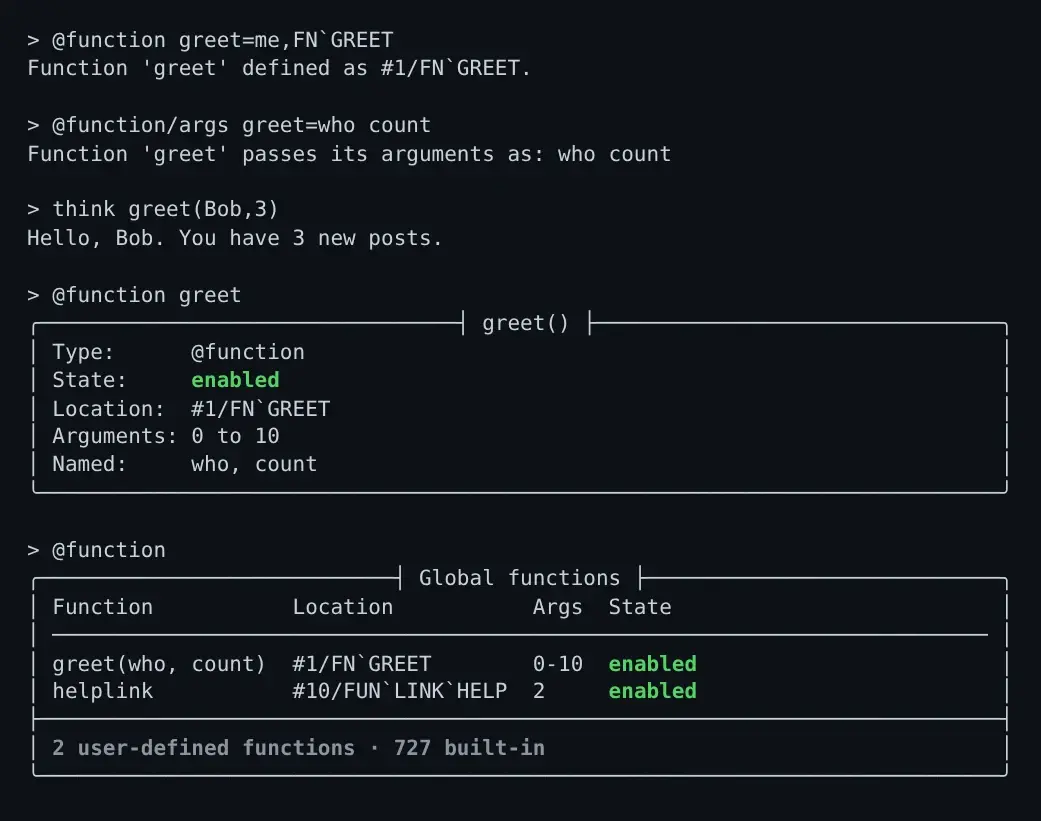
&FN`GREET me=Hello, %<who>. You have %<count> new posts.@function greet=me,FN`GREET@function/args greet=who countthink greet(Bob,3)Output: Hello, Bob. You have 3 new posts.
%0 and %1 still hold Bob and 3, so existing code keeps working. @function greet lists the
names, and @function/args greet= clears them.
@function/args needs the config.admin permission.
A variable number of arguments
Section titled “A variable number of arguments”The last name can take every argument after the ones before it. The shapes are the ones the
built-in functions use to describe their own parameters in your editor: switch()’s read
string, expression...|list..., default. A function of your own is declared the same way.
| Last name | The rest arrive as |
|---|---|
items... | items1, items2, …, and how many as itemscount |
key...|value... | dealt out in turn: key1, value1, key2, value2, …, each with a count |
case...|result... default | as above, and default takes the argument left over after whole pairs |
... | name and value pairs that the caller names |
A list of any length
Section titled “A list of any length”&FN`GLUE me=[iter(lnum(1,%<itemscount>),%<items##>,%b,%<sep>)]@function glue=me,FN`GLUE@function/args glue=sep items...think glue(-,a,b c,d)Output: a-b c-d
b c stays one argument even though it contains a space, because each argument keeps its own name.
Repeating groups
Section titled “Repeating groups”key...|value... deals the arguments out a group at a time, like dealing cards to two players:
&FN`LABELS me=[iter(lnum(1,%<keycount>),%<key##>: %<value##>,%b,%b|%b)]@function labels=me,FN`LABELS@function/args labels=key...|value...think labels(Name,Bob,Rank,Captain)Output: Name: Bob | Rank: Captain
A group can have more than two names (key...|value...|note...). If the last group is short, its
missing names are empty, and each name’s count says how many it got.
Groups with a default
Section titled “Groups with a default”A name after the group takes whatever is left once the whole groups are dealt, the way switch()
treats its last argument:
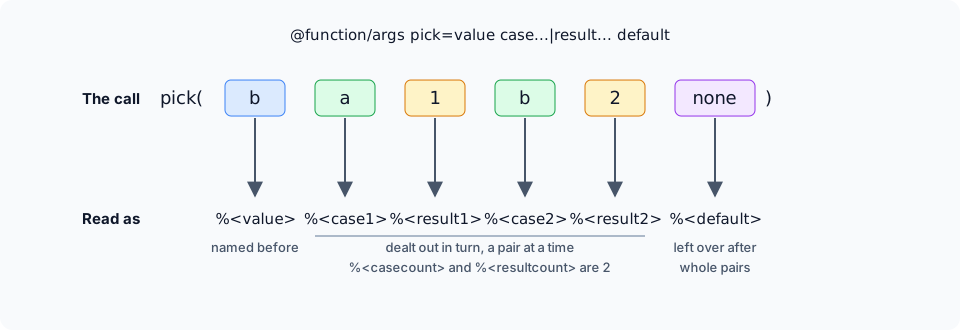
&FN`PICK me=[firstof(trim(iter(lnum(1,%<casecount>),if(strmatch(%<value>,%<case##>),%<result##>))),%<default>)]@function pick=me,FN`PICK@function/args pick=value case...|result... defaultthink pick(b,a,1,b,2,none)think pick(c,a,1,b,2,none)Output: 2, then none.
With an even number of arguments after value, nothing is left over and %<default> is empty.
Names the caller chooses
Section titled “Names the caller chooses”A bare ... lets each caller pick the names, the way uargs() does:
&FN`CARD me=%<title>: %<name>, %<rank>@function card=me,FN`CARD@function/args card=title ...think card(Crew,name,Bob,rank,Captain)Output: Crew: Bob, Captain
A call that leaves a pair unfinished returns #-1 NAMED ARGUMENTS COME IN PAIRS. A pair named with
nothing, a number, or one of the function’s own names (title here) returns
#-1 ARGUMENT NAME INVALID.
Lists @function/args refuses
Section titled “Lists @function/args refuses”@function/args answers #-1 ARGUMENT NAME INVALID and keeps the old names when:
- a name is repeated, ignoring case (
who WHO); - a name is a number;
- more than one name takes the rest (
key... value...; writekey...|value...); - a name follows a single
items..., since nothing would ever be left over for it.
Naming a command’s arguments for its hooks
Section titled “Naming a command’s arguments for its hooks”An @hook on a built-in command reads that command’s arguments as LS, RS, LSA1, LSA2 and
the others listed in help @hook registers. @command/args <command>=<names> gives them names of
your own, in order: the left side, then each right-side argument. The shapes above work here too.
&HOOK`CHOWN me=[attrib_set(me/LAST`CHOWN,%<attribute> to %<owner>)]@command/args @atrchown=attribute owner@hook/before @atrchown=me,HOOK`CHOWN&NOTE me=hello@atrchown me/NOTE=methink get(me/LAST`CHOWN)Output: me/NOTE to me
@command/args needs the config.admin permission and lasts until the server restarts, like the
other @command switches, so it belongs in a @startup too. A hook cannot refuse the command it is
attached to: when a command named with a bare ... is given an unfinished pair, its hook simply
gets none of the pairs.
Arguments the game names for you
Section titled “Arguments the game names for you”Some code is called by the game rather than by softcode, and the game passes it named arguments:
- Events: every argument, beside its position.
&OBJECT`MOVE #9=...reads the destination as%<destination>or%1.help event listgives each event’s names. - Feed tie-ins and taps:
%<id>,%<key>,%<speaker>,%<style>,%<text>,%<name>and the others inhelp @feed tie-ins. A name means the same value in ROUTE, DELIVER, FORMAT and a tap, whatever its position in each. - The HTTP handler:
%<path>and%<body>(also%0and%1),%<viewer>,%<headers>and one%<hdr.<name>>per request header. - Formats and filters:
CHATFORMAT,PAGEFORMATandOUTPAGEFORMAT,SPEECHMOD,MAILFILTER, the channel mogrifier’sMOGRIFYattributes,NAMEFORMAT,DESCFORMAT,CONFORMATandEXITFORMAT, and the Markdown templates. ACHATFORMATreads the message as%<message>or%2; each attribute’s help gives its names. @hookattributes:ARGS,LS,RS,EQUALS,SWITCHES,LSACandLSA1,LSA2, …@httpcallbacks:%<status>and%<content-type>, with the response body in%0.@inputcallbacks:%<reason>, which isexit,inputortimeout.- Regular-expression
$-commands: each named capture in the pattern. mapsql(): each column, by its name.
An event handler written for PennMUSH keeps working: the positions are unchanged, and the names come on top of them.